Pilz Equipment Selection Guide: From PNOZ s7 to PSSuniversal
Files to download
A guide to selecting Pilz equipment — from PNOZ s7 relays, through configurable PNOZmulti mm0.1p and modular PNOZ m B0 controllers, to distributed PSS 4000/PSSuniversal systems. The cost-effectiveness tipping point, applicability limits, and integration with other systems.
Pilz Equipment Selection Guide: From PNOZ s7 to PSSuniversal
In this article we present a guide to selecting Pilz equipment, from simple safety solutions based on PNOZ s7 relays, through compact configurable PNOZmulti Mini mm0.1p controllers, up to advanced distributed PSS 4000 / PSSuniversal systems. We'll cover key technical topics such as the cost-effectiveness tipping point, the applicability limits of each solution, and integration options with other industrial automation systems.
How does the PNOZ s7 differ from other Pilz solutions?
The PNOZ s7 is a contact expansion module designed to expand the number of outputs in conjunction with safety-related control components. It's a simple but limited solution. The PNOZ s7 C 24VDC 4 n/o 1 n/c variant has 4 safety normally-open (N/O) contacts and 1 auxiliary normally-closed (N/C) contact. Its width is 17.5 mm, with a power consumption of 2 W at a 24 V DC supply.
The PNOZ s7 uses plug-in spring-clamp terminals and complies with EN 60947-5-1, EN 60204-1, and VDE 0113-1. The module supports a monitored reset with a rising edge, providing feedback loop control in simple safety architectures.
How does the PNOZ s7 work?
The PNOZ s7 acts as an output expansion, allowing single- or dual-channel control from a master unit. It has N/O and N/C contacts, along with a feedback loop connection. It's a suitable solution for simple, dedicated single-purpose machines with minimal logic, where there's no ability to parametrize shutdown times outside of dedicated delay modules, no Boolean logic, and diagnostics limited to status LEDs.
Using the PNOZ s7 makes sense for machines requiring just one or two independent safety functions. However, when the need grows to three or four independent safety functions (for example 2× E-STOP, an OSSD light curtain, guard interlocking, and drive coast-down with stop monitoring), traditional contact expansion becomes economically and spatially inefficient due to cross-wiring costs, redundancy of potential-free contacts, and diagnostic difficulties.
The cost-effectiveness tipping point: from relays to configurable systems
The line between using traditional safety relays and switching to configurable systems typically falls at a need for 3–4 independent safety functions. At that point, the cost of cross-wiring, expansion with auxiliary contact modules, and diagnostic difficulties compared to a single programmable module make discrete solutions less cost-effective.
A compact configurable controller such as the PNOZ mm0.1p offers a much better cost-to-functionality ratio in such scenarios, eliminating the need to expand with multiple modules and simplifying diagnostics through centralized logic.
PNOZ mm0.1p: a bridge between relays and full controllers
The PNOZ mm0.1p (model 772001) is a compact configurable controller that bridges traditional relays and full PLC controllers. The module supports achieving Performance Level e (PL e) per EN ISO 13849-1 and Safety Integrity Level CL 3 (SIL CL 3) per EN IEC 62061.
PNOZ mm0.1p technical specifications
The PNOZ mm0.1p has the following parameters:
- 12 digital inputs
- 8 configurable inputs/outputs
- 4 test pulse outputs
- 4 semiconductor outputs – single-pole SC safe outputs, category 3
- Power supply: 24.0 V DC
- Power consumption: 35.0 W
- Dimensions: 45.0 mm (width) × 100.0 mm (height) × 120.0 mm (depth)
- Gross weight: 250 g, net weight: 231 g
- Ambient temperature range: 0 to 60 °C
- Maximum 1 expansion module
The semiconductor outputs are pulse-tested for cross-channel short circuits, ensuring safety at the PL e / SIL CL 3 level.
PNOZ mm0.1p configuration options and limitations
The PNOZ mm0.1p is programmed in an intuitive graphical environment. The module allows safety logic to be configured without traditional coding, making it accessible to maintenance engineers and system integrators.
However, the PNOZ mm0.1p has significant limitations:
- No ability to expand with I/O modules on the right side (unlike the mm0.2p, which has a link-connector option) – limited to a standalone configuration
- Limited logic memory (up to a few dozen function blocks)
- Communication interfaces implemented only via bus modules on the left side
- Maximum 1 expansion module
These limitations make the PNOZ mm0.1p an ideal solution for medium-complexity applications, but insufficient for systems requiring significant expansion or advanced network communication.
PNOZ m B0: modular safety controllers for complex applications
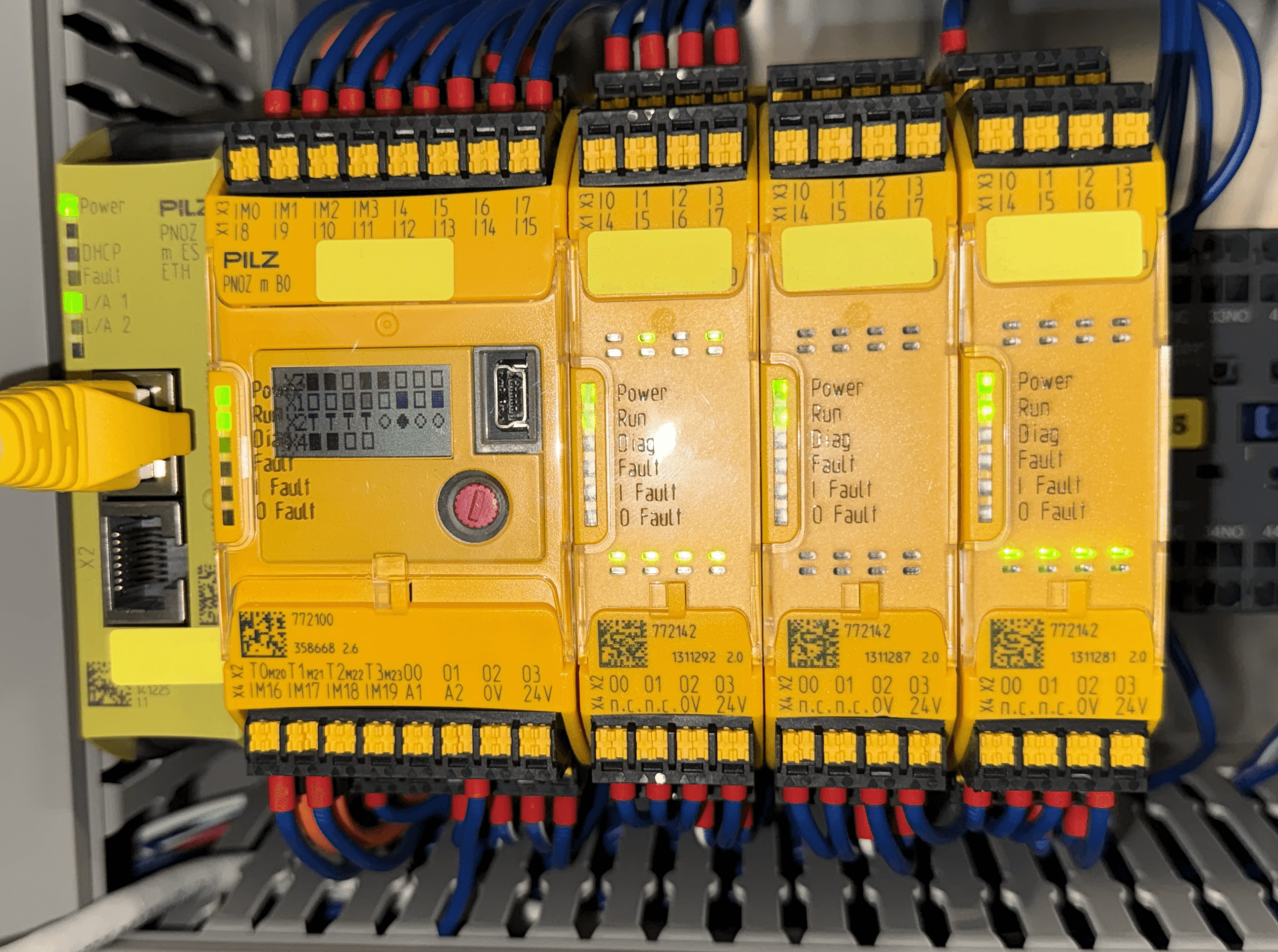
The PNOZ m B0 is a modular safety controller that represents the next step up in the hierarchy of Pilz systems. Unlike the PNOZ mm0.1p, the PNOZ m B0 offers flexible expansion via a system bus (backplane).
Architecture and expansion options
The PNOZ m B0 base unit can be expanded with binary I/O modules, analog and temperature input modules, and speed and safe-stop monitoring modules. The module supports Motion Safety functions such as SLS (Safe Limited Speed), SOS (Safe Operating Stop), and SDI (Safe Direction Indication) per IEC 61800-5-2.
Multi-Zone Safety and Cause & Effect logic
The PNOZ m B0 enables the implementation of complex Cause & Effect logic matrices for production lines, where triggering a light curtain stops only a single cell or robot without stopping neighboring conveyors and thermal processes. This functionality, known as Multi-Zone Safety, is key for large production systems.
Configuration memory and communication
The PNOZ m B0 supports removable flash cards for storing configuration, making it easier to manage and update safety logic. The module supports advanced mapping of diagnostic tags to higher-level fieldbuses via fieldbus modules for Profinet, EtherNet/IP, and Modbus TCP.
PSS 4000 / PSSuniversal: distributed automation and safety systems
The PSS 4000 is an advanced automation system designed for large-scale process installations and assembly lines. PSSuniversal I/O and PSS67 I/O handle both safety-related and non-safety-related signals at the field level.
Multi-Master architecture and SafetyNET p
The PSS 4000 / PSSuniversal enables a shift from a central controller to distributed PLCs for large-scale installations. The Multi-Master architecture, via the SafetyNET p real-time safety communication protocol, allows PLC units and I/O islands to be distributed without a traditional master-slave hierarchy, with deterministic failsafe data exchange and sub-millisecond response times.
PSSuniversal modulebus
The PSSuniversal modulebus supports up to 64 I/O modules, handling both safety and non-safety functions. This scalable architecture makes the PSS 4000 / PSSuniversal an ideal solution for distributed automation systems.
Programming in PAS4000
The PSS 4000 / PSSuniversal is programmed in the PAS4000 environment, which combines Standard Automation and Functional Safety logic. The environment supports IEC 61131-3-compliant languages such as STL (Statement List), LD (Ladder Diagram), and FBD (Function Block Diagram), as well as the PASmulti safety block editor.
Integration in a heterogeneous plant environment
Modern factories often use components from multiple manufacturers. Integrating Pilz safety islands with process control systems based on standard PLCs from other manufacturers requires a thoughtful approach.
Exchanging safety flags between systems
One approach is exchanging safety flags via optically isolated I/O, which provides galvanic separation between Pilz systems and other controllers. This solution is especially useful in environments requiring reliability and electromagnetic isolation.
Network gateway modules
For more advanced integrations, network gateway modules are available, allowing Pilz systems to connect to Profinet or EtherCAT networks. Such solutions allow for centralized diagnostics and management of the whole automation system.
Component availability – Enetiv
Enetiv is a supplier of machine safety and industrial automation components. Enetiv's portfolio includes Pilz equipment, from the PNOZsigma and PNOZ X relay series, through the PNOZmulti and PNOZmulti 2 systems, to the advanced distributed PSS 4000 system, PSENmag and PSENcode magnetic sensors, and PSENopt light curtains.
Support for multi-brand environments
Enetiv supports maintenance teams, panel builders, and system integrators in selecting replacement parts and safety components across multi-brand environments. We supply equipment from brands including:
- Siemens – F-CPU S7-1200F/1500F controllers, F-DI/F-DO ET 200SP modules
- Schneider Electric – Preventa systems and Modicon platforms
- Bosch / Bosch Rexroth – SafeMotion drives and SafeLogic controls
- Rockwell Automation – Allen-Bradley controllers and ControlLogix systems
- ABB and other brands available on the secondary market
Conclusions and call to action
Choosing the right Pilz equipment depends on the complexity of the application, the required safety functions, and the system's growth plans. The PNOZ s7 is an ideal solution for simple applications, the PNOZ mm0.1p is an effective bridge for medium-complexity applications, the PNOZ m B0 offers flexibility for modular systems, and the PSS 4000 / PSSuniversal provides scalable solutions for distributed automation.
If you're planning to implement a machine safety system or modernize an existing installation, get in touch with Enetiv. We'll help you verify component availability and select replacement parts, and if needed, we can also arrange on-site automation technicians.
Contact: https://enetiv.com/kontakt
FAQ
What is the PNOZ s7?
The PNOZ s7 is a contact expansion module designed to expand the number of outputs in conjunction with safety-related control components. The PNOZ s7 C 24VDC 4 n/o 1 n/c variant has 4 safety normally-open contacts and 1 auxiliary normally-closed contact, a width of 17.5 mm, and a power consumption of 2 W.
How does the PNOZ mm0.1p work?
The PNOZ mm0.1p (model 772001) is a compact configurable controller that bridges relays and full PLC controllers. It has 12 digital inputs, 8 configurable inputs/outputs, 4 test pulse outputs, and 4 semiconductor outputs. It supports PL e / SIL CL 3 and allows for a maximum of 1 expansion module.
How does the PNOZ m B0 differ from the PNOZ mm0.1p?
The PNOZ m B0 is a modular safety controller that allows for flexible expansion via a system bus (backplane) with binary I/O modules, analog and temperature modules, and Motion Safety modules. The PNOZ mm0.1p is a compact configurable controller with limited logic memory and a maximum of 1 expansion module.
What are the benefits of using the PSS 4000 / PSSuniversal?
The PSS 4000 / PSSuniversal offers decentralization and scalable solutions for distributed automation: support for up to 64 I/O modules on the PSSuniversal modulebus, a Multi-Master architecture with SafetyNET p real-time safety communication, and a single PAS4000 programming environment combining standard automation and safety function logic.