SIMODRIVE POSMO A 300 W - error, failure, repair: does the whole motor have to be replaced?
Files to download
A failed POSMO A 300 W does not always mean replacing the whole motor. See what can be replaced separately, what errors 700, 713 and 715 mean, and what to watch for when replacing the drive unit.
Do you have a faulty motor or servomotor? Please contact us.
SIMODRIVE POSMO A 300 W - error, failure, repair: does the whole motor have to be replaced?
When an axis stops, the fault may be in the motor, in the gearbox, or in the electronics that POSMO A has mounted directly on the motor. In a typical setup the amplifier sits in the cabinet and is replaced separately, but here there is nothing to take out of the cabinet, so the question arises right away whether the whole motor has to be replaced after a failure. SIMODRIVE POSMO A is a decentralized positioning motor with integrated drive electronics, connected to a PROFIBUS DP bus. The manufacturer lists packaging machines, wood and glass processing machines, printing and plastics processing machines, and machine tools as typical applications. Trade press has also described it in a dosing machine, where such motors set the stops of cylinders to an accuracy of thousandths of a millimeter.
The drive unit of this variant is currently listed in the Siemens catalog as a spare part with a discontinued (end-of-production) status, so the question of repairing rather than replacing the whole unit is very much a live one in maintenance. The answer depends on the diagnostic result and on what can be replaced separately.
What a POSMO A 300 W consists of and what is replaced separately
A single POSMO A unit combines a power module, a motor, a positioning controller and, optionally, a gearbox. Communication runs over PROFIBUS DP and power can be supplied through a common power bus, so the installation takes up less space in the cabinet and needs smaller cable ducts and less wiring, which is most visible where many such motors work on one machine. The price of this compactness is that an electronics failure stops the axis even though the motor with its gearbox may be fully functional.
In the 300 W variant the electronics, i.e. the drive unit, is a separate element mounted on the motor, and the manufacturer's manual describes its replacement only for this variant. The unit is removed from the motor with four hex socket screws, SW 3, so an electronics fault does not mean the whole drive has to be replaced. Replacement of the connection module, the planetary gearbox and the motor alone is also described separately, which lets you match the scope of the repair to what is actually damaged. Enetiv repairs such drive units, and when a repair makes no sense, we supply a working replacement, used or refurbished.
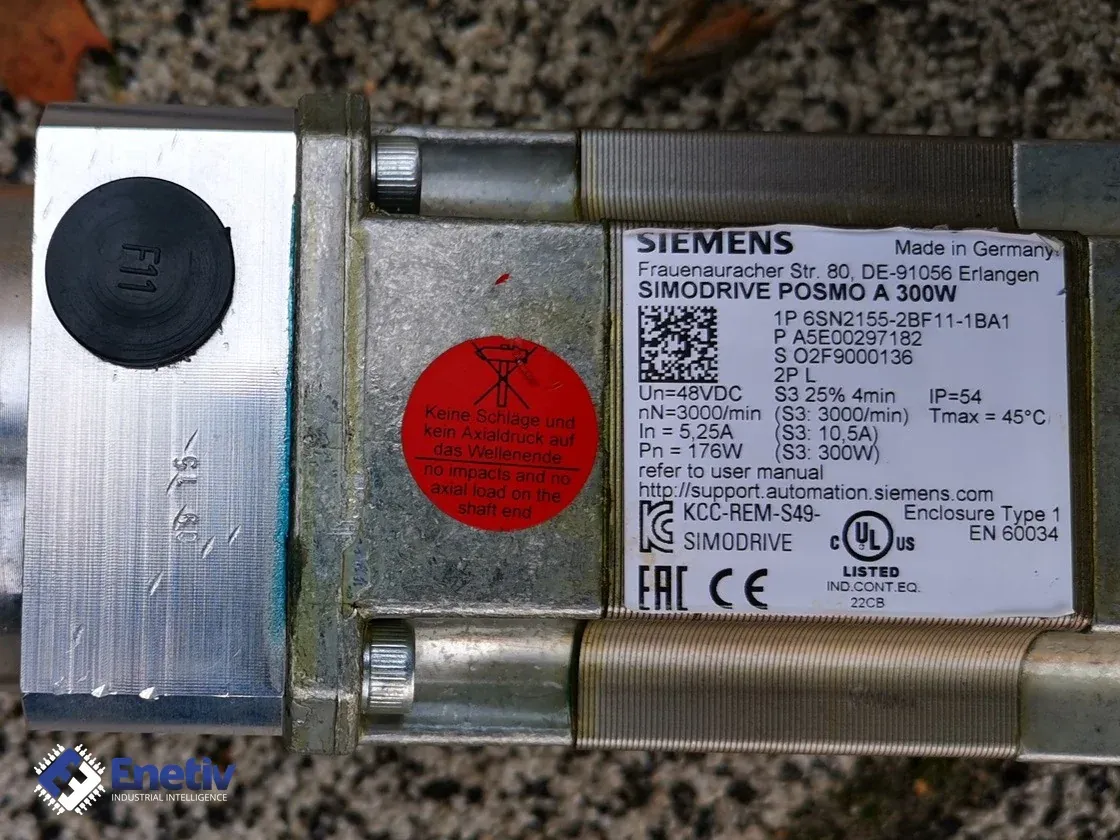
It is also worth remembering that the motor delivers 300 W only in intermittent duty (S3, 25 %, in a four-minute cycle), while in continuous duty (S1) its power is 176 W at a 48 V DC supply. A constant load above this value is an overload, so when looking for the cause of a failure you need to check whether the axis is being operated this way.
POSMO A errors 700, 713 and 715 - diagnostics before the decision
The first clue is the LED on the motor: if it is off or lit steady red, the manual refers you to the chapter on error handling and diagnostics. Parameter P947 shows bitwise which errors are active, and parameter P954 gives additional information which, according to the manufacturer, allows errors and warnings to be diagnosed precisely. It can be read over PROFIBUS, with SimoCom A, or from SIMATIC Manager, and saving these values before disassembly gives you a reference point after the replacement.
Three error numbers appear most often, and each one steers the next decision differently:
- 700, overvoltage (bit P947.0): the supply voltage exceeded 60 V in the 300 W version. Among the causes, the manual lists the SITOP power supply switching off during braking, excessive load or friction, a faulty bus cable with EMC interference, and a faulty drive. With a switched-mode power supply, the manufacturer requires protection against regenerated braking energy, e.g. with a DC-PMM module, so before deciding on a replacement you need to check the power supply arrangement.
- 713, loss of the reference point (P947.13): the drive was moving when it was switched off or it had not been referenced, so it is enough to reference (home) the axis again and this is not a fault.
- 715, system error (P947.15): an internal fault of the drive was detected, and for the 300 W motor the manual points to replacing the drive unit, not the whole motor.
The error number together with a photo of the nameplate is usually enough for a preliminary assessment of whether the problem lies in the power supply or in the drive unit, and Enetiv accepts such requests through the contact form.
Repair or replacement of the POSMO A drive unit
Because the drive unit is now a spare part with discontinued production, the availability of new units is limited, so in practice the options are repairing the damaged unit or using a working used or refurbished one. A repair makes sense when the motor and gearbox are in good condition and the fault is in the electronics, for example with error 715. A replacement is faster when the axis has to return to operation immediately and a repair alone would mean waiting. In both cases diagnostics come first, because replacing a working unit will not remove an overvoltage whose source is the power supply.
What to watch out for when replacing
- The same type. The manufacturer requires the same type to be used when replacing a drive unit or a motor, because otherwise some parameters may give different axis behavior.
- Marking on the housing. The order number of the 300 W motor has the form 6SN2155-xy-1BA1: with x = 1 the motor/drive assembly has degree of protection IP64 (gearbox IP54), with x = 2 the whole unit is IP65, and y = 1 means the version with a holding brake, y = 0 without a brake. The 75 W version is designated 6SN2132-…, so the number immediately shows that it is a different variant.
- Connection cover and supply. The cover from a 75 W motor does not fit a 300 W motor and vice versa, and the 75 W version is supplied with 24 V DC, the 300 W with 48 V DC, so parts from another unit must first be compared by number.
- Hardware and software version. It can be read from parameters P52 and P53, and the drive identification from P964, which lets you choose a replacement compatible with the parameterization.
- Brake. In a motor with a brake, the supply voltage must exceed 24 V DC, and the brake is intended only for a limited number of emergency stops and must not be used as a service brake, so its operation has to be checked after installation.
- Connectors and seals. After removing the cover, inspect the connectors, contacts and seals, and plug all unused entries, because the degree of protection after reassembly depends on it.
- Axis position. After the connection cover is removed the position is not retained, so the axis has to be referenced again, and after an encoder replacement it has to be calibrated from scratch.
- Used parts. A used part should have documented origin and be checked before installation.
General replacement steps
The replacement starts with saving the parameters and establishing which part is damaged, after which the power is disconnected, the damaged element is removed and the new one is installed. After connecting, you check the PROFIBUS address and the terminating resistor on switch S1 in the connection cover, and after start-up the inputs and outputs and communication with the bus. The whole procedure ends with documenting the changes, so that the state after the repair can be compared with the record made before disassembly.
Repair and POSMO A parts in one place
Enetiv works in industrial automation from two sides: we supply parts and we repair them. We supply components from Allen-Bradley (Rockwell Automation), Siemens, Schneider Electric, Bosch Rexroth and ABB, carry out diagnostics and repair drives, including POSMO A drive units, inverters, servo drives, I/O modules and controllers, and service motors and servomotors, with our own warranty on repairs. We also specialize in end-of-life (EOL) parts and service, including older-generation and unusual components. For a POSMO A 300 W, a photo of the nameplate and a description of the symptoms with the error number are enough, and the reply will show whether a repair is sufficient or whether a working drive unit or the whole motor is the better choice. Please contact us.