Yaskawa SGMSH-15DCA6F-OY (Sigma-II): How to Read the Type Designation and Choose a Replacement for a Discontinued Servo Motor
Files to download
Yaskawa SGMSH (Sigma-II) servo motors still drive axes in many machines, even though the manufacturer has discontinued them. Learn how to decode the SGMSH-15DCA6F-OY designation, what to watch out for when choosing a replacement and what data to prepare before ordering.
Yaskawa SGMSH-15DCA6F-OY (Sigma-II): how to read the type designation and choose a replacement for a discontinued servo motor
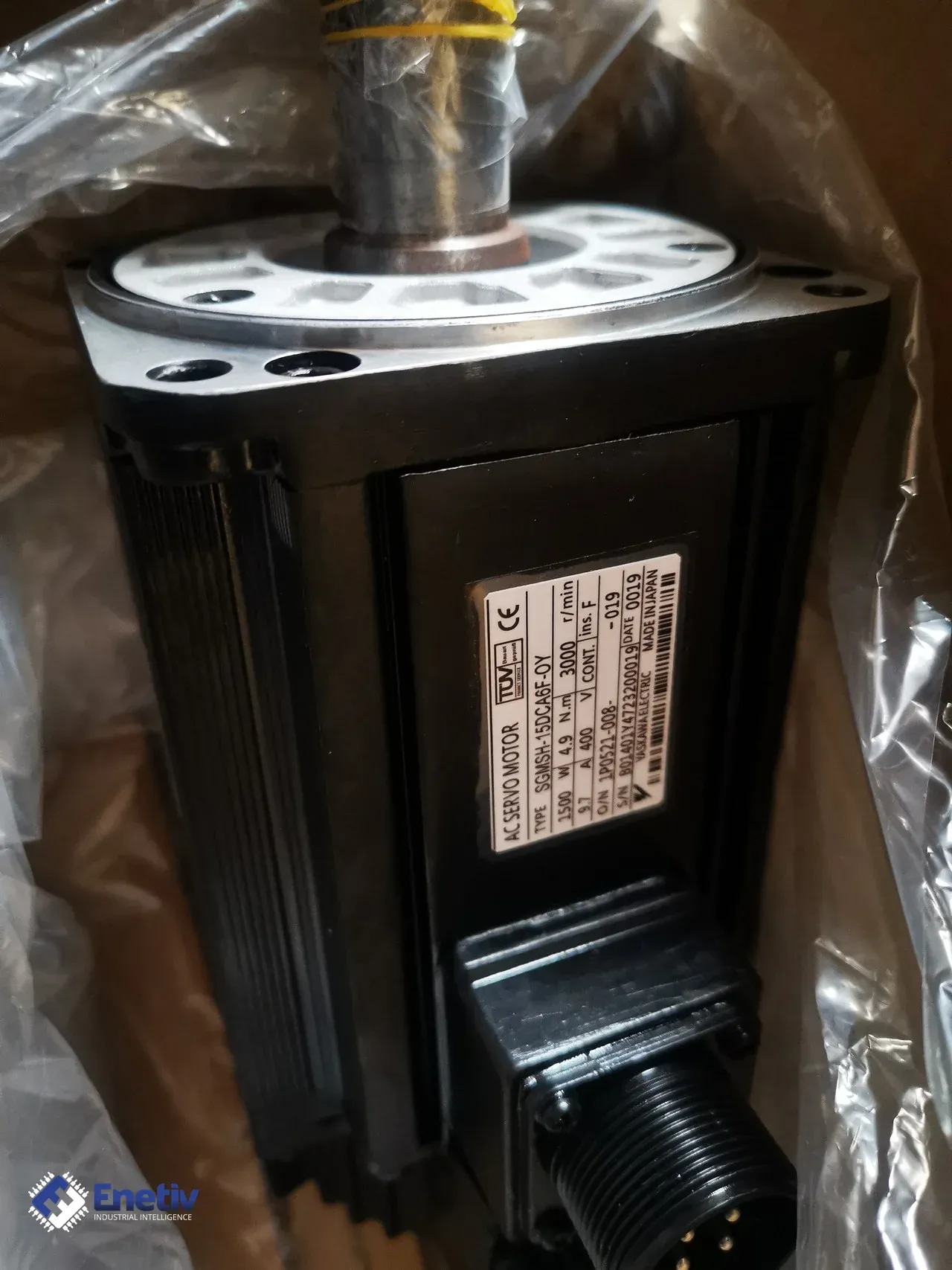
Yaskawa SGMSH (Sigma-II) servo motors still drive axes in many machines, even though the manufacturer has discontinued them. When such a motor fails, buying a new unit with the same designation can be difficult, and choosing a replacement starts with the nameplate and the type designation, which encodes the supply voltage, encoder type, shaft shape and additional equipment. A good example is the SGMSH-15DCA6F-OY motor, whose designation can be decoded almost entirely using the manufacturer's catalog.
How the SGMSH-15DCA6F-OY type designation is built
Whether a replacement matches the original in supply, encoder and shaft depends on decoding the designation. SGMSH is the Sigma II series of servo motors, and the number 15 is the power code: in the manufacturer's data this model has 1.5 kW and a rated torque of 4.9 Nm. The letter D means a 400 V supply, so the replacement must work with a servo drive for that voltage.
The character C means a 17-bit incremental encoder, and in versions with a 17-bit absolute encoder this position holds "2", so two motors with the same power and voltage may require different servo drive settings. The letter A is the design revision, and the digit 6 appears in models described as having a straight shaft with key and tapped hole, which must be compared with the actual shaft. The letter F means the version without a brake, and in the version with a brake this position holds "H". The OY suffix denotes a variant whose meaning must be confirmed from the motor's serial number. In the manufacturer's listing, the SGDH-15DE-OY servo drive is assigned to this motor.
What to watch for when replacing
- Encoder. The motor has a 17-bit incremental encoder, so the type and resolution must be compared with the designation and nameplate of the replacement. The manufacturer states that a motor with an absolute encoder can replace an incremental motor without changing operation, and that the SGDH servo drive reads an absolute encoder as incremental after Pn002.2=1 is set. This applies to the SGDH servo drive and does not remove the need to check the rest of the designation.
- Shaft. The designation indicates a straight shaft with key and tapped hole. This must be compared on the actual shaft and against the manufacturer's drawing.
- Sealing. Before mounting, it is worth inspecting the shaft and housing and checking whether the replacement has the same design.
- Brake. The F designation indicates the version without a brake. A replacement with a brake ("H" in the designation) requires power for the brake coil, for which the manufacturer gives a current of 0.29 A for size 15, so with such a swap you must check whether the cabinet has a suitable power supply and a brake control output.
- Cables and connectors. The "CE" versions of the power and encoder cables have a flexible (continuous-flex) cable, whereas the standard cable for larger SGMSH motors is not intended for continuous flexing. The contacts and plugs must also be inspected.
- Nameplate and labels. Before removal, photograph the nameplate and record the power, torque, speed and type number.
- Vibration at the mounting location. The manufacturer notes that vibration exceeding the specification of Sigma II motors can trigger alarm A.84 (A84).
A used unit should additionally be inspected for damage to the housing, shaft and connectors, tested before installation, and its documentation of origin should be kept.
What data to prepare before ordering a replacement
A replacement that matches in mechanical, electrical and environmental parameters is easiest to identify when the inquiry contains the full data of the original motor. It is worth attaching the full type designation, the serial number and a photo of the nameplate to the inquiry, because the serial number also makes it possible to establish the meaning of the OY suffix. Interchangeability of motors, cables or servo drives should not be assumed without comparing the designations.
General replacement steps
The replacement starts with a backup of the servo drive parameters, followed by reading the nameplate and type designation and selecting the replacement. Next come mechanical mounting together with the coupling, connecting the power and encoder, and commissioning. The whole process ends with a motion test and documenting the changes.
Enetiv works in industrial automation from two sides: we supply parts and we repair them. We carry PLC controllers, inverters, HMI panels and external devices as new, used and refurbished, including brands such as Allen-Bradley (Rockwell Automation), Siemens, Schneider Electric, Bosch Rexroth and ABB. We also specialize in end-of-life (EOL) parts and service, including older-generation and unusual components. We diagnose and repair inverters, servo drives, I/O modules and controllers, and we also service motors and servomotors. Contact us at enetiv.com/kontakt.