Single Pair Ethernet in the cabinet: WAGO 852-2112 switch (4 SPE ports + 2×10/100BASE-TX) – how to connect it to classic Ethernet (WAGO 852-1816, 852-1705 converter), when it replaces fiber and what changes in cabling and shielding
Files to download
How do you connect a Single Pair Ethernet segment to a classic copper network, and when can SPE replace fiber? See what to watch for when swapping devices and what changes in cabling and shielding.
Single Pair Ethernet in the cabinet: WAGO 852-2112 switch (4 SPE ports + 2×10/100BASE-TX) – how to connect it to classic Ethernet (WAGO 852-1816, 852-1705 converter), when it replaces fiber and what changes in cabling and shielding
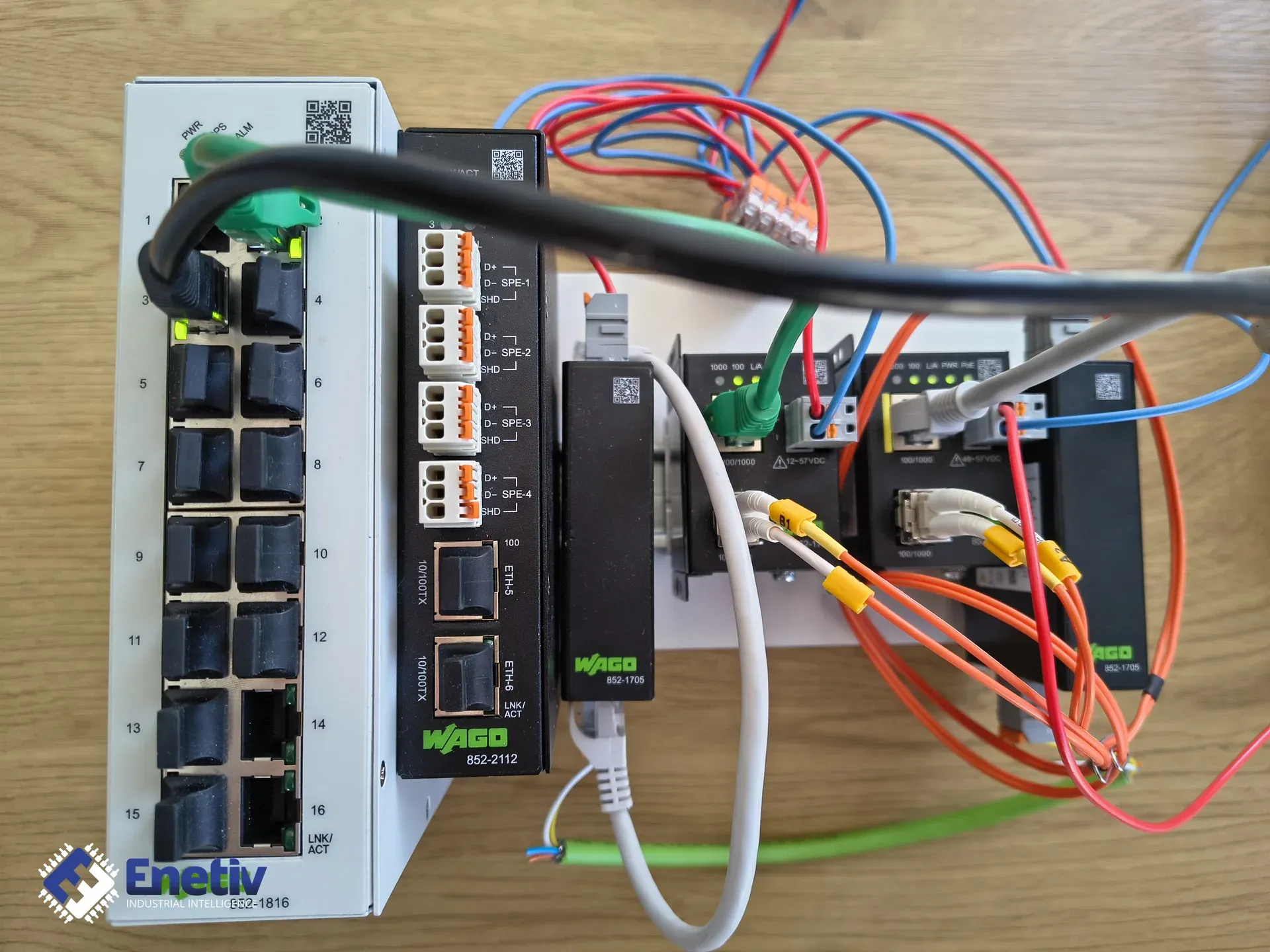
Single Pair Ethernet is Ethernet transmitted over a single pair of wires, created so that sensors, controllers and other field devices can be connected to the network without running classic, multi-pair cabling. It appears in control cabinets, at remote network points and with devices distributed around a facility, so a maintenance technician meets it more and more often, also where until now only classic Ethernet over copper twisted pair has been used. On the SPE side, this example uses the WAGO 852-2112 switch and the WAGO 852-1705 media converter, while the classic copper network is represented by the WAGO 852-1816 managed switch.
The three devices in brief
Both SPE devices, that is the WAGO 852-2112 and the WAGO 852-1705, carry 10 Mbit/s Ethernet over Single Pair Ethernet over a distance of up to 1000 m, and they differ in the number and type of ports, as the table below shows.
| Parameter | WAGO 852-2112 | WAGO 852-1705 |
|---|---|---|
| Ports | two RJ45 10/100BASE-T ports and four Single Pair Ethernet 10BASE-T1L ports | one RJ-45 10BASE-T port and one Single Pair Ethernet 10BASE-T1L port |
| Maximum range | 1000 m | 1000 m |
The WAGO 852-2112 is an industrial ECO switch that connects four SPE ports with two copper RJ45 ports, so in one housing it collects several SPE devices and leads them out to the classic network. Transmission takes place over shielded twisted pair, and the two RJ45 ports support automatic speed detection (auto-negotiation), so 10/100 Mbit/s devices are connected on a plug-and-play basis. The WAGO 852-1705, on the other hand, is a media converter that translates one SPE port into one RJ-45 port, and therefore serves a single point, for example one remote Ethernet device.
The WAGO 852-1816 is a completely different class: a managed switch with 16 10/100/1000BASE-T ports, that is a classic copper network with clearly higher port throughput, to which the SPE segment is attached through an RJ45 port. It has redundant power supply with function monitoring by means of a relay, supports RSTP for mesh and ring networks, and enables configuration backup and restore. The SPE segment therefore does not require a separate upstream network, only one copper port in such a switch.
As for fiber, the manufacturer states that networking remote Ethernet devices by means of the 852-1705 converter and the 852-2112 switch can replace DSL modems or fiber-optic cables. Similarly, two 852-1705 converters make it possible to connect remote Ethernet devices over a distance of up to 1000 m. This matters above all where a copper cable already exists, because using the existing wires can noticeably reduce the cost of connecting distributed sensors to the automation system.
What to watch for when replacing
- Segment speed: the SPE segment runs at 10 Mbit/s, while the copper ports can be faster, so at the boundary between the two worlds it is the SPE segment that determines the available throughput.
- Port type: SPE 10BASE-T1L ports and RJ45 ports are not interchangeable, so the cable has to be assigned to the correct socket, and in the case of SPE to the lever connector.
- Range: the manufacturer states a maximum of 1000 m on shielded twisted pair, and this value should not be assumed for other types of cable.
- Converter power supply: the WAGO 852-1705 requires a 24 VDC supply, so before commissioning make sure that the correct voltage is available in the cabinet.
- Full designation: the number and variant should be read from the nameplate, because the 852 family contains many similar designations and versions.
- Inspection: before installation it is advisable to examine the connectors and terminals, the condition of the conductors and the shield, the LEDs on the housing and the labels with the device version.
- Testing and documentation: communication is checked with a test device, and in the case of a used part it is worth keeping the documented origin of the unit together with its serial number.
Cabling and shielding
An SPE cable is a shielded twisted pair, which means that when replacing a classic RJ45 patch cord, not only the number of wires changes but also the way the cable is terminated. The manufacturer describes the connection directly: the wire is cut to the appropriate length, the insulation is stripped and the conductors are inserted into the connector, and in the lever connector, after raising the lever, two stripped conductors are inserted and the lever is lowered, so the connection is secure and requires no tools. The Push-in CAGE CLAMP® terminal used accepts solid, stranded and fine-stranded conductors, and in the 852-1705 converter the SPE cable is connected precisely to the CAGE CLAMP lever connector.
In addition, there are good-practice rules that do not depend on the model. The SPE cable should be routed separately from power cables, because a long twisted pair close to inverters and power supplies easily picks up interference. The shield must be continuous along the entire route, and its connection is made according to the manual of the given device, without your own grounding variants. The insulation is stripped carefully, without nicking the conductors, and the conductors are clamped securely in the connector and checked with a light pull. It is worth labeling the conductors and cables so that years later it is clear which section leads to which port.
General steps for commissioning and replacement
- Make a backup of the configuration of the classic network switch to which the SPE segment is attached, for example the 852-1816, which enables configuration backup and restore.
- Identify the device on the basis of the nameplate and compare it with the unit being replaced.
- Mount it on a DIN rail in the cabinet, leaving room for cable routing.
- Carry out the cabling and connect the shield according to the manual, labeling the conductors.
- Connect the power supply, for the 852-1705 converter a voltage of 24 VDC.
- Start up and check the LEDs on the housing.
- Test communication between the SPE segment and the copper network, for example by accessing a device from the other side of the link.
- Record in the cabinet documentation the model, serial number, version and cable route.
Frequently asked questions
Can the 852-2112 switch be connected to the 852-1816 switch?
Yes, on the classic network side the 852-2112 has two RJ45 10/100BASE-T ports, and the 852-1816 has 10/100/1000BASE-T copper ports, so the connection is made with a copper cable between these ports. The SPE segment still runs at 10 Mbit/s.
Can the 852-1705 converter work on its own?
The converter forms one end of the SPE link, so on the other side of the cable a second 852-1705 converter or an SPE port of the 852-2112 switch must be operating; the manufacturer describes precisely these two arrangements, both with the converter powered at 24 VDC.
Enetiv works in industrial automation from two sides: we supply parts and we repair them. We have new, used and refurbished parts from brands including Allen-Bradley (Rockwell Automation), Siemens, Schneider Electric, Bosch Rexroth and ABB, we diagnose and repair inverters, servo drives, I/O modules and controllers, we service motors and servomotors, with our own warranty on repairs. We also specialize in end-of-life (EOL) parts and service, including older-generation and unusual components. Please contact us at https://enetiv.com/zapytanie.