24V DC Backup Power in the Control Cabinet – Comparing Siemens SITOP DC-UPS 6EP1931-2FC21, Phoenix Contact QUINT-UPS/24DC/24DC/10-20 and PULS UB10.241/UB20.241, and Battery Diagnostics
Files to download
How to compare Siemens SITOP DC-UPS, Phoenix Contact QUINT-UPS and PULS UB10.241/UB20.241 in terms of battery architecture, SOC/SOH/SOF diagnostics and communication interfaces, and how to catch battery degradation before it causes a failure.
24V DC Backup Power in the Control Cabinet – Comparing Siemens SITOP DC-UPS 6EP1931-2FC21, Phoenix Contact QUINT-UPS/24DC/24DC/10-20 and PULS UB10.241/UB20.241, and Battery Diagnostics
In modern control cabinets, a loss of 24V DC power can cause PLC data loss, IPC corruption, and shutdown of safety circuits. Three leading solutions – Siemens SITOP DC-UPS 6EP1931-2FC21, Phoenix Contact QUINT-UPS/24DC/24DC/10 and QUINT-UPS/24DC/24DC/20, and PULS UB10.241 and PULS UB20.241 – differ in battery architecture, diagnostic methods, and communication interfaces. This guide explains how each system monitors battery condition and what steps to take to catch degradation before it causes a failure.
Why is 24V DC backup power in the control cabinet critical for PLCs and safety systems?
Industrial control systems rely on a stable 24V DC supply for digital inputs, output modules, and safety subsystems (e.g., emergency outputs). When power is lost, PLC non-volatile memory can lose its current state, and safety systems may stop monitoring critical signals, increasing the risk of uncontrolled machine startup. In addition, IPC controllers that store configurations and logs are vulnerable to corruption during a sudden power loss. This is why 24V DC backup power in the control cabinet is essential for preserving data integrity and production line continuity.
What are the key technical features of the Siemens SITOP DC-UPS 6EP1931-2FC21 module, and which batteries does it support?
The Siemens SITOP DC-UPS 6EP1931-2FC21 module is available in a 40A variant and works with replaceable battery modules from the 6EP1935 family. The most commonly used batteries are 6EP1935-6MC01 (1.2 Ah) and 6EP1935-6MF01 (12 Ah). Verified manufacturer data lists the following parameters:
- Input: 24V DC (range 22…29 V) from the SITOP power supply.
- Output current: 40 A (without an additional communication interface – "without interface").
- Charging current: 0.3 A for the 6EP1935-6MC01 module (1.2 Ah); for the 6EP1935-6MF01 module (12 Ah), the manufacturer specifies a proportionally higher charging current (in the range of 2-3 A), with a factory-set charging value for the overall system of 2 A ± 0.2 A.
- Additional battery variants: 6EP1935-6MD31 (2.5 Ah, temperature range –40°C … +60°C – confirmed in the manufacturer's technical data).
The available documentation does not include a detailed description of SOC/SOH diagnostics or communication interfaces (e.g., USB, PROFINET). In practice, battery status monitoring in the Siemens system therefore relies mainly on relay signals and LED indicators rather than advanced digital analysis. Siemens' approach is more modular than predictive – the user selects the battery variant to match application requirements and ambient temperature, then monitors output voltage under load.
How does the battery management system work in the Phoenix Contact QUINT-UPS/24DC/24DC/10-20, and what diagnostic functions does it offer?
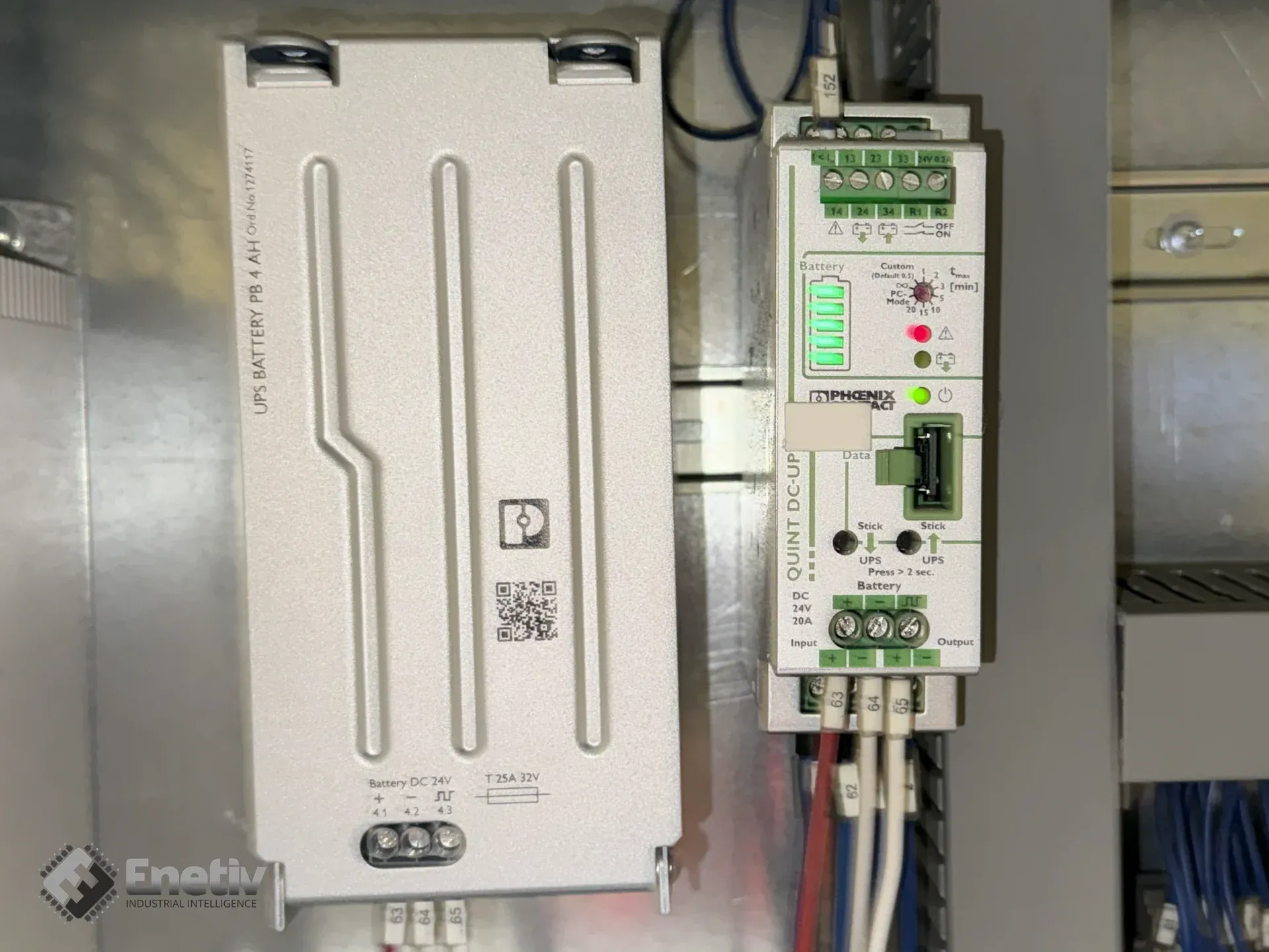
The Phoenix Contact QUINT-UPS/24DC/24DC/10 and QUINT-UPS/24DC/24DC/20 family uses IQ Technology, which integrates an intelligent battery management system (BMS). According to the datasheet, the 10A variant (order no. 2320225) supports a maximum charging current of 2.88 A (IUoU charging method: constant current → compensation → float/trickle charge), while the 20A variant has a verified charging-process current draw of 6.9 A (the exact battery charging current itself is not stated explicitly in the available documentation – it is worth confirming directly with the manufacturer when selecting a unit). Both variants accept a 24V DC input voltage and deliver a 24V DC output at the rated output current (10 A or 20 A, with Power BOOST capability). Key diagnostic functions include:
- State of Charge (SOC) calculation – current charge level and estimated remaining runtime under a given load.
- State of Health (SOH) calculation – forecast of remaining battery life and service life.
- State of Function (SOF) calculation – current assessment of the energy storage device's ability to deliver the required power.
- Display of remaining runtime and service life on the user interface.
- LED status indicators (red/green) and the ability to transmit data to a PC/host system via communication interfaces – verified for the 10A variant: USB (IFS-USB-DATACABLE) and RS232 (IFS-RS232-DATACABLE). PROFINET is not documented for this product family – industrial interfaces (such as EtherNet/IP) only appear in the newer QUINT4-UPS generation, in variants with the /EIP suffix, which are separate products.
- Continuous battery health monitoring through the intelligent battery management system (BMS).
Thanks to continuous SOC, SOH, and SOF monitoring, operators can anticipate when a battery replacement will be needed based on alarm thresholds set in the software. Phoenix Contact offers the richest set of diagnostic functions among the three compared solutions, making it an excellent choice for applications that require predictive maintenance.
What sets the PULS UB10.241 and PULS UB20.241 apart in terms of battery monitoring and charging?
The PULS UB10.241 and PULS UB20.241 systems differ in battery topology. The UB20.241 uses a dual 12V configuration (2 × 12 V in series), with each battery charged and monitored individually thanks to the 1-Battery-Concept – once the center-tap connection is installed, each of the two 12V batteries has its own independent charger. This allows voltage imbalances to be detected and only the faulty unit to be replaced. The UB10.241 uses a single charging path stepped up to 24 V; the details of this concept in the 10A version are not fully confirmed in the available sources.
Key, verified PULS features:
- Temperature-compensated charging – a PT1000 temperature sensor regulates the end-of-charge voltage (from 2×13.1 V to 2×14.2 V per 12V battery, over the range -10°C…+50°C), extending battery life.
- A built-in battery size selector with "small" (<10 Ah, 1.5 A charging current, -10°C…+50°C range) and "large" (>10 Ah, 3 A charging current, -40°C…+50°C range) settings.
- Individual charging of each 12V battery – two independent battery chargers ensure even discharge across the series connection.
- Diagnostics include a battery presence test (every 10 seconds), a dynamic impedance test (every 4 hours), and three-color LED signaling indicating operating status, faults, and service needs.
- Deep-discharge protection – automatic battery disconnection at 10.5 V / 9.0 V.
- Communication: an 8-pin signal connector with relay outputs (Ready, Buffering, Replace battery) and LEDs; detailed digital interfaces (e.g., USB) are not documented for this product family.
- No requirement for matched batteries – matching batteries are unnecessary thanks to individual monitoring of each unit.
How do the battery testing, signaling, and communication capabilities compare across the three 24V UPS systems?
The key differences between the three systems are as follows:
- Siemens SITOP DC-UPS 6EP1931-2FC21 – no built-in load test or internal resistance measurement; signaling limited to relays and LEDs; no standard communication interface; modular architecture with replaceable batteries 6EP1935-6MC01 (1.2 Ah, 0.3 A charging), 6EP1935-6MF01 (12 Ah), and 6EP1935-6MD31 (2.5 Ah, -40°C…+60°C).
- Phoenix Contact QUINT-UPS/24DC/24DC/10-20 – active SOC, SOH, and SOF monitoring, remaining runtime display, data transmission via USB/RS232 (10A variant); both relay-based and digital alarms; intelligent battery management system (BMS) with continuous health assessment; maximum charging current of 2.88 A for the 10A variant (for the 20A variant, the exact battery charging current should be confirmed with the manufacturer).
- PULS UB10.241 and PULS UB20.241 – individual monitoring of each 12V battery (1-Battery-Concept), temperature-compensated charging with a PT1000 sensor, a battery size selector (1.5 A / 3 A), battery presence test and dynamic impedance test, relay-based and LED warning signals; no documented digital interfaces such as USB.
In practice, if predictive diagnostics (SOC/SOH/SOF) and remote data readout are the priority, the Phoenix Contact solution offers the richest feature set. For applications where simplicity and modularity matter most, Siemens SITOP provides solid backup power with minimal configuration effort. PULS, on the other hand, stands out for its flexible approach to managing two 12V batteries and its precise temperature-compensated charging, which is especially important in control cabinets with variable thermal conditions.
What maintenance best practices help prevent a sudden 24V DC backup power failure?
1. Cabinet temperature control – both Siemens and PULS state that battery selection depends on the ambient temperature range (e.g., the 6EP1935-6MD31 operates in –40°C … +60°C, and PULS's "large" mode in -40°C…+50°C). Keeping the temperature within 20°C ± 5°C minimizes accelerated degradation. The PULS UB20.241 and UB10.241 offer temperature-compensated charging (PT1000 sensor), which automatically adjusts the end-of-charge voltage to thermal conditions.
2. Regular load testing – for systems without a built-in load test (Siemens SITOP), it is recommended to manually connect a resistive load at 80% of maximum output current for 30 minutes to assess voltage drop. PULS performs an automatic battery presence test (every 10 s) and a dynamic impedance test (every 4 h), while Phoenix Contact QUINT-UPS testing can be supported by the BMS.
3. Internal resistance monitoring – the PULS UB10.241/UB20.241 perform this automatically via the dynamic impedance test; otherwise, an external meter can be used and results logged in a database. Rising internal resistance is an early indicator of battery degradation.
4. Interpreting alarm signals – LED and relay warnings should be mapped in the PLC program (e.g., in TIA Portal) to variables that trigger service actions (such as displaying a message, logging an event, or activating an emergency mode). On Phoenix Contact units, SOC, SOH, and SOF signals can be read via USB/RS232 (10A variant) using UPS-CONF software.
5. Battery replacement planning – based on SOH data (Phoenix Contact QUINT-UPS), voltage-drop trends under constant load (Siemens SITOP), or individual monitoring of each 12V battery and the 10.5 V/9.0 V deep-discharge threshold (PULS UB20.241), set a threshold indicator (e.g., SOH < 70% or voltage < 22 V) as the replacement point. For the Siemens 6EP1931-2FC21, the 6EP1935-6MF01 battery module should be replaced once the voltage under load drops below 22 V.
6. Firmware updates – Phoenix Contact provides UPS-CONF software for parameterization and diagnostic readout; it is worth checking with the manufacturer for firmware updates for the specific model before deployment, as the scope of diagnostic functions can vary between hardware versions.
FAQ
How do I check whether the battery in a Siemens SITOP DC-UPS 6EP1931-2FC21 needs replacing?
The Siemens SITOP system has no built-in SOH indicator, so the safest approach is to monitor voltage under load and check whether the alarm relay switches when voltage drops below 22 V. In addition, a regular load test (80% of output current for 30 minutes) allows you to assess the voltage drop; if the drop is significant, the battery should be replaced. The 6EP1935-6MF01 (12 Ah) or 6EP1935-6MC01 (1.2 Ah) module should be replaced with a new, compatible model.
What do the SOC and SOF indicators mean on the Phoenix Contact QUINT-UPS/24DC/24DC/10-20?
SOC (State of Charge) indicates the current battery charge level and the estimated remaining runtime under the current load. SOF (State of Function) reports the energy storage device's current ability to deliver the required power at a given moment. Together with SOH (State of Health), they provide a complete picture of battery condition thanks to the intelligent battery management system (BMS, IQ Technology).
Can the PULS UB20.241 operate without matched batteries?
Yes. The PULS UB20.241 system provides individual charging and monitoring for each of its two 12V batteries (1-Battery-Concept), eliminating the need for perfectly matched capacities. However, using batteries of similar health is recommended to avoid uneven discharge. Each battery is charged by an independent charger (two independent battery chargers), ensuring an even load distribution.
What communication interfaces are available on the Phoenix Contact QUINT-UPS/24DC/24DC/10?
Verified manufacturer documentation (order no. 2320225) confirms the availability of USB (IFS-USB-DATACABLE) and RS232 (IFS-RS232-DATACABLE) interfaces for communicating with a PC and reading diagnostic data (SOC, SOH, SOF, remaining runtime) via UPS-CONF software. PROFINET is not documented for this model – industrial network interfaces appear in the newer QUINT4-UPS generation, in variants with the /EIP suffix (EtherNet/IP).
What are the most important factors affecting battery life in a control cabinet?
Ambient temperature, discharge cycle depth, charging current, and uneven discharge (particularly in 2 × 12V configurations) are the key factors. Systems with temperature-compensated charging (PULS UB10.241 and UB20.241 with a PT1000 sensor) and continuous status monitoring (Phoenix Contact SOC/SOH/SOF) allow earlier detection of battery degradation than systems relying solely on periodic voltage checks (Siemens SITOP).
Sources
- Phoenix Contact – QUINT-UPS/24DC/24DC/10, datasheet (order no. 2320225, SOC/SOH/SOF, charging current, USB/RS232 interfaces): https://media.digikey.com/pdf/Data%20Sheets/Phoenix%20Contact%20PDFs/2320225_Ds.pdf
- Phoenix Contact – QUINT-UPS/24DC/24DC/10 product page (communication interfaces, IFS cables): https://www.phoenixcontact.com/en-us/products/uninterruptible-power-supply-quint-ups-24dc-24dc10-2320225
- Phoenix Contact – QUINT-UPS/24DC/24DC/20, datasheet (order no. 2320238, charging-process current draw): https://s3.amazonaws.com/crumelectric/crumelectric/content/1986_Phoenix_Contact_2320238_Specification_Sheet.pdf
- Siemens – datasheet 6EP1935-6MF01 (SITOP Battery module 24V/12Ah): https://support.industry.siemens.com/teddatasheet/?format=pdf&mlfbs=6EP1935-6MF01&language=en&caller=SIOS
- Siemens – technical data 6EP1935-6MC01 (1.2 Ah, 0.3 A charging): https://my.goagilix.com/assets/88/2b/882b3419-aa15-4570-ace8-3775191218f9/Siemens_6EP19356MC01_Specification_Sheet.pdf
- Siemens – technical data 6EP1935-6MD31 (2.5 Ah, -40°C…+60°C): https://www.electricautomationnetwork.com/en/siemens/6ep1935-6md31-6ep19356md31-siemens-sitop-pure-lead-battery-module-24-v-25-ah-with-service-free-sealed-lead-ac
- PULS GmbH – UB20.241 datasheet (2×12V topology, PT1000, battery size selector, diagnostic tests): https://products.pulspower.com/mwdownloads/download/link/id/2244