Choosing a 24V DC DIN-Rail Power Supply: Puls SLA3, Siemens SITOP PSU8200, Allen-Bradley 1606-XLE, Omron S8VK-G12024/G03024 and Mean Well DRP-240-24
Files to download
How to safely select a replacement 24V DC DIN-rail power supply across brands like Puls, Siemens, Allen-Bradley, Omron and Mean Well – electrical compatibility, mounting dimensions, and overload protection profiles.
Selecting a 24V DC DIN-Rail Power Supply: Puls SLA3, Siemens SITOP PSU8200, Allen-Bradley 1606-XLE, Omron S8VK-G12024/G03024 and Mean Well DRP-240-24
Replacing a 24 V DC power supply in a control cabinet requires precisely matching electrical parameters, dimensions, and protection behavior. This step-by-step guide explains how to assess compatibility across brands – Puls, Siemens, Allen-Bradley, Omron, and Mean Well – to avoid surprises during operation.
How do you check electrical compatibility when replacing a 24V DC power supply?
How do you match the input and output voltage range?
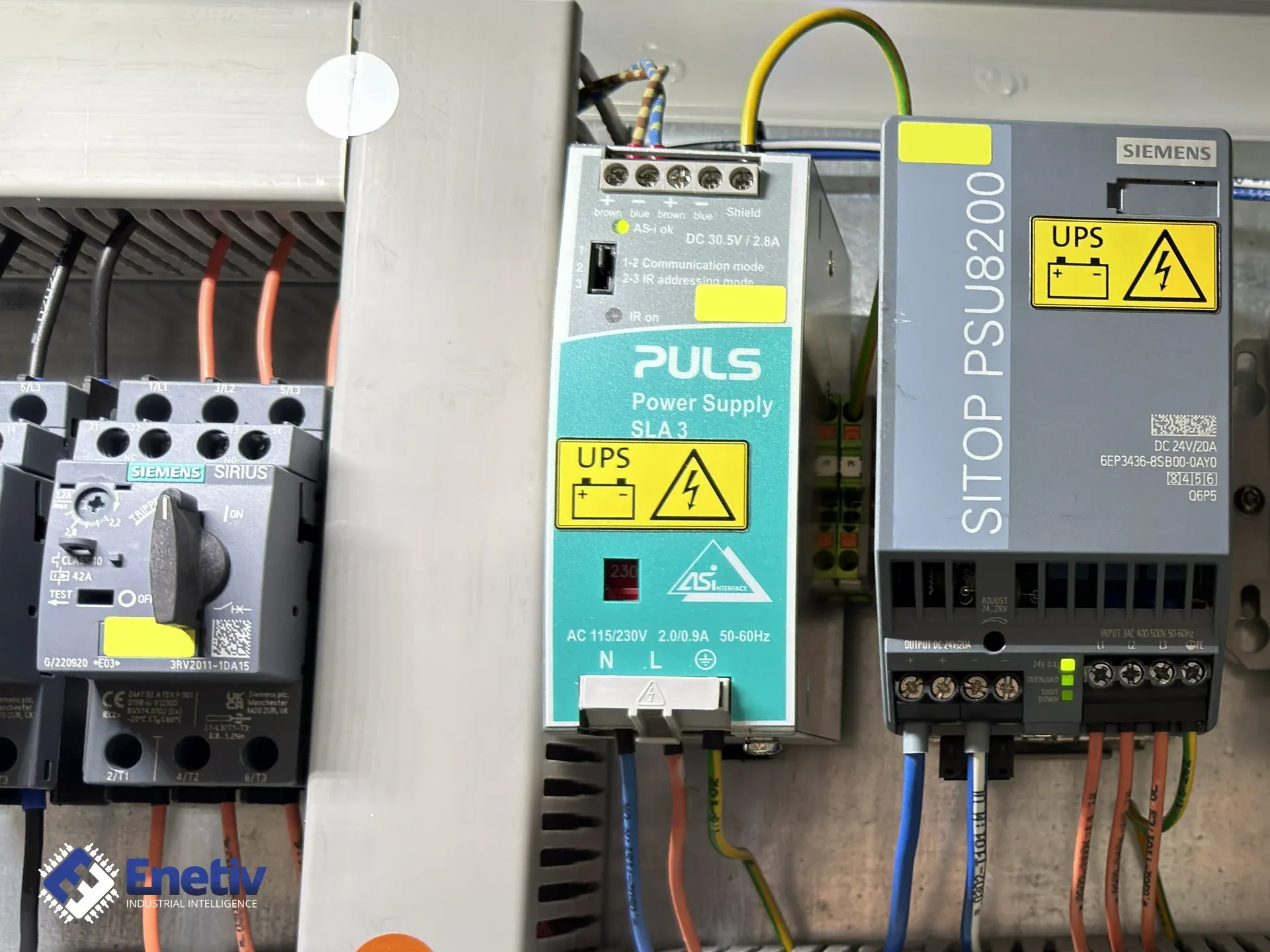
The starting point is comparing the input voltage range (AC or DC) and the output voltage (24 V DC in typical PLC controller applications). The power supply must deliver a stable 24 V DC at the required rated current while also tolerating mains voltage fluctuations as specified by the manufacturer. For example, the Siemens SITOP PSU8200 24 V/40 A variant (model 6EP3337-8SB00-0AY0, 1AC input) accepts 85–132 V AC or 170–264 V AC input, allowing it to work across different geographic regions. The Puls SLA3.100, on the other hand, runs on 100–120 / 220–240 V AC input (-15%/+10%), but its output is 30.6 Vdc – making it an unsuitable replacement for standard 24 V DC applications, since it's a specialized power supply for AS-Interface networks rather than a general-purpose 24 V DC unit.
How do you evaluate rated and maximum current?
Output current defines how many amps the connected system can draw. Choose a replacement whose rated current is at least equal to, or higher than, what's required by the controller and connected I/O modules. The Siemens SITOP PSU8200 offers variants from 10 A to 40 A (e.g. model 6EP3436-8SB00-0AY0 delivers 20 A on a 400–500 V 3AC input, and model 6EP3437-8SB00-0AY0 delivers 40 A from the same input range). The Puls SLA3.100 only provides 2.8 A at 30.6 V, which is insufficient for most applications requiring higher-current 24 V DC. Peak current matters for short-duration loads, such as motor or battery inrush.
Why do efficiency and noise levels matter?
High efficiency (≥ 90%) limits heat losses and reduces cooling requirements. The Puls SLA3.100 achieves a typical efficiency of 90.5% with typical losses of 10.5 W / 9.1 W, while the Siemens SITOP PSU8200 24 V/10 A variant (model 6EP3334-8SB00-0AY0) is rated at 94% efficiency. Noise and ripple should be < 50 mV pp or lower, so as not to disturb sensitive analog circuits and ADC converters in PLC controllers. The Puls SLA3.100 guarantees a maximum of 50 mVpp, which is at the borderline of acceptability for sensitive applications.
How do you account for tolerances and margins when switching brands?
Different manufacturers define their own output voltage tolerances (e.g. ± 5%). When replacing a unit, maintain a safety margin of at least 10% between the power supply's maximum allowed voltage and the load's minimum requirement. These tolerances are described below.
Table: Electrical Parameter Checklist for 24V DC PSU Replacement
| Parameter | Criticality | Why it matters for cross-brand compatibility | Recommended tolerance/matching margin |
|---|---|---|---|
| Input voltage range | High | Ensures operation across mains variations and allows use across different regions | ± 10% of manufacturer's nominal |
| Nominal output current | High | Ensures connected controllers won't be overloaded | ≥ 100% of required current |
| Peak current / power boost capacity | Medium | Handles short-duration startup loads | ≥ 150% of nominal current for ≤ 5 s |
| Ripple & noise | Medium | Protects sensitive analog inputs and digital communication | ≤ 50 mV pp |
| Efficiency rating | Low | Reduces heat losses and cooling requirements | ≥ 90% at full load |
How do you verify the dimensions and mounting requirements of a DIN-rail power supply?
How do you compare module width and height?
Width (mm) determines how much space the power supply takes up on the DIN rail. Replacing it with a wider unit may force a cabinet layout rework or additional brackets. The Puls SLA3.100 has a compact width of 49 mm and dimensions of 49 x 124 x 102 mm, making it ideal for tight panels, though its 30.6 V DC / 2.8 A output limits it to AS-Interface applications. The Siemens SITOP PSU8200 24 V/40 A variant is 135 mm wide, requiring more rail space, while the 24 V/10 A variant is significantly more compact at 55 x 125 x 125 mm. The Mean Well DRP-240-24 (240 W, 24 V/10 A) has case dimensions of 125.5 x 125.2 x 100 mm – a footprint comparable to the larger SITOP PSU8200 variants rather than a compact module, which should be factored into cabinet space planning. Height and depth affect terminal access and cooling requirements.
Which terminal types and mounting clearances are critical?
Most DIN-rail power supplies use screw terminals or spring-clamp connectors. The Puls SLA3.100 is fitted with screw terminals, the standard for industrial applications. A mismatched terminal type may require additional adapters or cabling. Clearances from the rail edges (top/bottom, left/right) must meet IEC 60204-1 requirements for a safe installation.
How do you check cooling and clearance requirements?
Some models (e.g. the Siemens SITOP PSU8200 40 A) require a minimum clearance of 20 mm from other components for adequate air circulation. Failing to provide this can lead to overheating and a shortened MTBF. The Puls SLA3.100 requires smaller clearances (≥ 10 mm) thanks to its lower power and better heat dissipation.
Table: Mechanical and Environmental Installation Constraints
| Constraint | Standard range/value | Impact of mismatch | Actionable verification step |
|---|---|---|---|
| Width on DIN rail | 49–135 mm (model-dependent) | Rail overcrowding, cabinet rework needed | Measure the available free slot before purchase |
| Mounting clearance top/bottom | ≥ 20 mm (at 40 A) | No ventilation → overheating | Check the manufacturer's thermal documentation |
| Mounting clearance left/right | ≥ 10 mm from adjacent modules | Short-circuit risk under vibration | Use a mounting template |
| Connection terminal type | Screw (M5) or spring-clamp | Mismatched connectors → adapter needed | Verify the type in the technical documentation |
| Derating temperature threshold | -25°C to 70°C (typical) | Exceeding the limit → reduced performance | Check the environmental conditions at the installation site |
What are the overload protection profiles and how do they affect the application?
What is Hiccup mode and when should you use it?
Hiccup mode briefly shuts off power when an overload is detected, then automatically restarts. It's useful in applications where brief interruptions won't disrupt the process, such as measurement systems. The Puls SLA3.100 uses input current limiting via an NTC thermistor as a form of overload protection.
How does constant current (U-I) work in the context of power supplies?
The Constant Current (U-I) profile maintains a steady output current as voltage drops, which is beneficial when powering motors or batteries where current control is required. The Siemens SITOP PSU8200 typically implements a Constant Current characteristic with foldback, protecting the power supply from overheating under sustained overload.
When should you choose Latch-off / Foldback protection?
Latch-off / Foldback mode permanently shuts the power supply off until a manual reset, increasing safety in critical systems (e.g. machine safety control). Foldback additionally limits current after restoration, protecting against renewed overload.
Table: Overload Protection Profiles & Application Suitability
| Protection type | Operating mechanism | Best suited for (load types) | Risks/limitations when replacing with an alternative type |
|---|---|---|---|
| Hiccup mode | Short-cycle shut-off, auto-restart | Loads with tolerable brief interruptions (sensors, low-speed drives) | Repeated cycling can shorten component life |
| Constant Current / U-I characteristic | Regulates current, allows voltage droop | Motor drives, battery charging, high-inrush loads | May require an external inrush limiter for very high peaks |
| Latch-off / Foldback | Permanent shut-off until manual reset, current limit after reset | Safety-critical circuits, emergency-stop power supplies | Long downtime if reset isn't performed promptly |
Comparing the five most popular 24V DC DIN-rail power supply models
The Puls SLA3.100 delivers a 30.6 V DC output at 2.8 A, making it an unsuitable replacement for higher-current 24 V DC applications; its 49 x 124 x 102 mm dimensions and 500 g weight make it a compact solution for AS-Interface applications, though its 2 W/°C derating above +60°C needs attention in hot environments. The Siemens SITOP PSU8200 24 V/40 A (model 6EP3337-8SB00-0AY0 for 1AC 120/230 V input, model 6EP3437-8SB00-0AY0 for 400–500 V 3AC input) delivers up to 40 A and a wide 85–264 V AC input range, plus IECEx and ATEX certification (Ex nA nC IIC T4 Gc) for hazardous-area applications. The 24 V/10 A variant (model 6EP3334-8SB00-0AY0, 240 W) measures 55 x 125 x 125 mm and is rated at 94% efficiency. Allen-Bradley 1606-XLE and Omron S8VK-G12024/G03024 require additional technical data that should be obtained from the supplier or manufacturer to ensure full compatibility. The Mean Well DRP-240-24 is a budget-friendly 240 W option with case dimensions of 125.5 x 125.2 x 100 mm and standard overload protection, offering a good price-to-performance ratio for general-purpose applications – though it's worth noting that despite matching the power of the smaller SITOP PSU8200 variants, it takes up noticeably more DIN-rail space than the compact 10 A models.
How to choose the right power supply replacement – practical steps
Step 1: Identify the exact model of the power supply being replaced
Note the serial number and model (e.g. Siemens SITOP PSU8200 6EP3337-8SB00-0AY0, Puls SLA3.100, Mean Well DRP-240-24). The model number encodes input (AC/DC, voltage), output (24 V DC, current), and certifications.
Step 2: Compare electrical parameters
Make sure the replacement has:
- An input range that covers the available mains voltage (e.g. 85–264 V AC for the Siemens SITOP PSU8200)
- Output current ≥ required (e.g. 40 A for the Siemens SITOP PSU8200 24 V/40 A)
- 24 V DC output ± 5% (24 V DC for the Siemens SITOP PSU8200, not 30.6 V DC like the Puls SLA3.100)
- Efficiency ≥ 90% (Puls SLA3.100: 90.5%, Siemens SITOP PSU8200: 94%)
- Ripple < 50 mV pp (Puls SLA3.100: 50 mVpp)
Step 3: Check dimensions and mounting requirements
Measure the available DIN-rail space and compare it against the power supply's width (Puls SLA3.100: 49 mm, Siemens SITOP PSU8200 40 A: 135 mm, Mean Well DRP-240-24: 125.5 mm). Check the required cooling clearances (≥ 20 mm for the Siemens SITOP PSU8200 40 A, ≥ 10 mm for the Puls SLA3.100).
Step 4: Verify terminal and connection type
Make sure the terminal type (screw, spring-clamp) is compatible with the existing wiring. The Puls SLA3.100 and Siemens SITOP PSU8200 both use standard M5 screw terminals.
Step 5: Check certifications and standards
For hazardous-area (Ex) applications, IECEx or ATEX certification is required (the Siemens SITOP PSU8200 carries the Ex nA nC IIC T4 Gc marking on select variants). For marine installations, check the availability of classification certificates (e.g. GL, ABS), and for the North American market, cULus approval (UL 508 / CSA C22.2 No. 107.1). Before buying a replacement, compare the certification list required by the industry standards applicable to your installation against what the chosen model actually holds – a missing required certification can disqualify a unit from formal approval for use, even if its electrical and mechanical parameters match.
If you're still unsure which model will be a safe replacement after going through these steps – especially for the Allen-Bradley 1606-XLE or Omron S8VK, whose full technical data is best verified directly with the supplier – it's worth consulting a technical team before placing an order. Enetiv advises on selecting 24 V DC power supply replacements from brands such as Siemens, Allen-Bradley, Schneider Electric, and others, offering both new parts and verified used or refurbished units. For help with selection and a current quote, contact the Enetiv team via enetiv.com/contact.
Sources
- PULS GmbH – SLA3.100, product page (electrical data, dimensions, AS-Interface application): https://products.pulspower.com/en/sla3-100.html
- Siemens – SITOP PSU8200 1ph, operating manual (efficiency, dimensions, ATEX/IECEx/cULus certifications): https://cache.industry.siemens.com/dl/files/279/92575279/att_40839/v1/SITOP_PSU8200_1ph_Handbuch_englisch_en-US.pdf
- Siemens – data sheet 6EP3437-8SB00-0AY0 (SITOP PSU8200/3AC/24VDC/40A): https://support.industry.siemens.com/teddatasheet/?format=pdf&mlfbs=6EP3437-8SB00-0AY0&language=en&caller=SIOS
- Siemens – data sheet 6EP3436-8SB00-0AY0 (SITOP PSU8200/3AC/24VDC/20A): https://support.industry.siemens.com/teddatasheet/?format=pdf&mlfbs=6EP3436-8SB00-0AY0&language=en&caller=SIOS
- Mean Well – DRP-240-24, technical data and case dimensions: https://www.advantageelectricsupply.com/part/mean-well/drp-240-24/626711
- Mean Well – DRP-240-24, product page: https://www.mouser.com/en/ProductDetail/MEAN-WELL/DRP-240-24