Danfoss FC-302 vs PowerFlex 753 – Detailed Parameter Comparison and Selection Guide
Files to download
A detailed comparison of the Danfoss VLT AutomationDrive FC-302 and Rockwell PowerFlex 753 drives — power ranges, vector control (VVC+ vs. sensorless vector), EtherNet/IP and open-protocol integration, safety (STO, Safe Stop), and IP ratings. Selection guidance for specific industrial applications.
Danfoss FC-302 vs PowerFlex 753 – detailed parameter comparison and selection guide
Automation engineers looking for precise data to choose a VFD that matches their application's requirements will find this comparison useful. Here we break down the most important features of the Danfoss FC-302 and Allen-Bradley's PowerFlex 753, analyzing power ranges, control algorithms, communication capabilities, and mechanical construction — giving you a practical answer to which drive fits your project better.
What are the power ranges and market positioning of the Danfoss FC-302 and PowerFlex 753?
Both drives cover voltage classes of 200-240 V, 380-500 V, 600 V, and 690 V, but differ in their upper power ceiling, which affects which industrial segments they target.
Power ranges – Danfoss FC-302 (0.25 kW-1,200 kW) vs. PowerFlex 753 (0.37 kW-250 kW)
The Danfoss VLT AutomationDrive FC-302 offers a wide power range from 0.25 kW at 208 V up to 1,200 kW at 690 V in the 12-pulse variant. The range also includes 0.34 hp at 230 V, 0.37–500 kW at 400 V, 0.5–650 hp at 460 V, 1–100 hp at 575 V, and 1.1–750 hp at 575 V. The Rockwell PowerFlex 753, on the other hand, is optimized for low and medium power, topping out at 250 kW at 380-480 V, 0.37–132 kW at 200–240 V, 1.0–300 hp at 600 V, and 7.5–250 kW at 690 V, beyond which Rockwell moves customers to the PowerFlex 755 family. Before ordering a specific variant, it's worth verifying the exact power limit in the current Rockwell Automation datasheet (Reference Manual 750-SR002), since manufacturers periodically update the available configurations.
Market positioning and target segments
The FC-302 is marketed as a universal drive, ideal for applications that require high power and protocol flexibility. The PowerFlex 753, meanwhile, targets plants that already run the Logix/Studio 5000 platform and need fast integration into an EtherNet/IP environment. In practice, the FC-302 reaches deeper into high-power territory, while the PowerFlex 753 stays focused on low and medium industrial power.
What vector control methods do the Danfoss FC-302 and PowerFlex 753 offer?
The choice of control algorithm has a major impact on positioning precision, energy consumption, and system dynamics.
VVC+ and vector control in the Danfoss FC-302
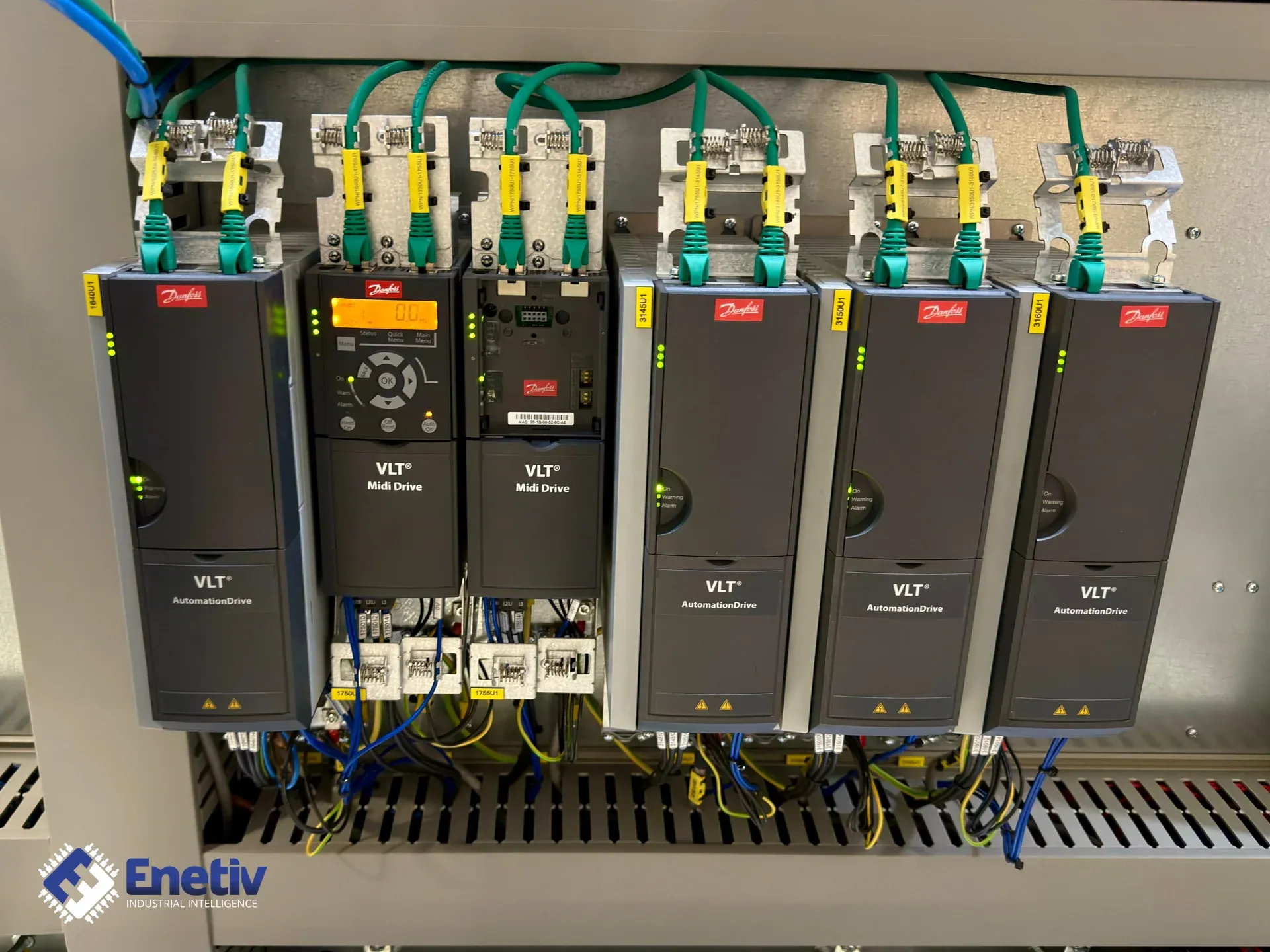
The FC-302 uses VVC+ technology along with flux vector control, delivering smooth acceleration and deceleration across frequencies from 0 Hz to 1000 Hz. Built-in Automatic Motor Adaptation (AMA) and Automatic Energy Optimization (AEO) functions enable automatic motor calibration and power-draw optimization. The Danfoss VLT AutomationDrive FC-302 also includes a built-in DC-link choke, which reduces harmonic distortion in line with the IEC-1000-3-2 standard.
Sensorless vector control in the PowerFlex 753
The PowerFlex 753 is based on sensorless vector control, allowing motors to be started without encoders while maintaining high speed accuracy. Built-in I/O and an optional Brake Chopper module support applications requiring fast stopping. The PowerFlex 753 family supports machine and plant control architectures through integrated positioning capabilities.
What does integration with control systems look like – EtherNet/IP, Logix vs. open protocols?
Communication compatibility drives integration cost and deployment time.
Rockwell's ecosystem – EtherNet/IP and Logix integration
The PowerFlex 753 offers native EtherNet/IP communication as well as an optional dual-port module, enabling direct connection to Logix/Studio 5000 controllers. The drive is recognized as a control-system component, which simplifies configuration in Project Builder and RSLogix 5000. Optional ControlNet, DeviceNet, RS485 DFI, PROFIBUS DP, and Modbus/TCP ports are also available.
Open protocols and Danfoss tools – MCT 10, MyDrive Suite
The FC-302 comes standard with RS485, USB, and Modbus RTU ports, and additionally supports optional networks (Profibus DP, PROFINET, CANopen, Modbus TCP) via plug-in cards. The MCT 10 tool and MyDrive Suite software allow the drive to be parametrized and diagnosed without connecting it to the plant's control network. The Danfoss VLT AutomationDrive FC-301/FC-302 is positioned as broadly compatible with popular fieldbus protocols, and its plug-in technology makes upgrades and retrofits easier.
What are the differences in construction, modularity, and IP ratings?
Mechanical design affects durability, ease of servicing, and enclosure fit.
Modularity and slots – Danfoss FC-302 vs. PowerFlex 753
The FC-302 uses plug-in technology, offering up to 4 expansion slots (communication, RFI/EMC filtering, an additional safety module). The PowerFlex 753 has a maximum of 2 expansion slots, including an optional ControlNet or DeviceNet module. Danfoss describes the FC-302 as a ruggedized design that reduces the effects of vibration, and it uses a back-channel cooling concept that shrinks the cooling system's footprint and energy cost while extending the unit's service life.
Safety functions and filtering
The FC-302 integrates Safe Torque Off (STO) and Safe Stop, meeting the requirements of Category 3 / Performance Level d-e under the EN ISO 13849-1 standard (the successor to the withdrawn EN 954-1), with Safe Stop available as standard. A Profisafe option is also available. A built-in RFI/EMC filter and DC-link choke reduce harmonic interference. The PowerFlex 753 offers an optional Safety I/O module and a standard RFI filter, but no built-in choke.
IP ratings and enclosure versions
The FC-302 is available in IP00, IP20, IP21, IP54, IP55, and IP66 versions, with UL Type 1, Type 12, and Type 4X enclosure options, allowing installation in environments with elevated corrosion risk. The PowerFlex 753 comes in IP00/IP20 (open-type), IP54 (NEMA/UL Type 12), and a flange-mount version.
Which drive should you choose for specific industrial applications?
The decision depends on application requirements, existing infrastructure, and energy priorities.
Scenario A – Water/wastewater, HVAC, pumps and fans
In systems where broad motor compatibility, energy-consumption optimization, and the ability to connect to different protocols (Modbus, Profibus, CANopen) matter most, the FC-302 offers a better fit thanks to its AMA and AEO functions and extended power range up to 1,200 kW. The Danfoss VLT AutomationDrive FC-302 provides integrated condition-based monitoring for uptime and early warning of sine-wave filter degradation and cavitation.
Scenario B – Industrial plants with a dominant Allen-Bradley environment
If a plant runs Logix controllers and a Studio 5000 environment and needs fast integration into an EtherNet/IP network, the PowerFlex 753 is the natural choice. Its optional dual-port EtherNet/IP module and integration with Rockwell's architecture speed up deployment.
Scenario C – Dynamic applications and precise positioning
For machines requiring fast acceleration, smooth braking, and precise vector control, the FC-302 with VVC+ and a built-in motion controller offers an edge over the PowerFlex 753's sensorless vector control. Danfoss VLT FlexConcept and its integrated motion controller support advanced positioning applications.
Scenario D – High power above 250 kW
When power above 250 kW is needed, the FC-302 is the only option among the drives analyzed here, supporting up to 1,200 kW at 525-690 V, including a 12-pulse variant for 3×380–690 V and 250–1,200 kW.
In summary, choosing between the Danfoss FC-302 and PowerFlex 753 should be based on an analysis of communication requirements, power range, and the specifics of the application.
Featured snippet: The Danfoss VLT AutomationDrive FC-302 covers a power range from 0.25 kW to 1,200 kW, offering VVC+, flux vector control, and a wide range of communication protocols (Modbus RTU, Profibus DP, PROFINET, CANopen), making it an ideal choice for applications requiring high power and open integration.
Featured snippet: The Rockwell PowerFlex 753 provides native EtherNet/IP communication along with optional ControlNet and DeviceNet ports, enabling seamless integration with Logix controllers in a Studio 5000 and RSLogix 5000 environment.
Featured snippet: The Danfoss FC-302 offers up to four expansion slots, built-in safety functions (STO and Safe Stop, Category 3 / PL d-e per EN ISO 13849-1), and RFI/EMC filtering with a built-in DC-link choke, increasing reliability in demanding industrial conditions.
Featured snippet: In the application matrix, the Danfoss FC-302 is best suited to HVAC systems, pumps, and high-power applications, while the PowerFlex 753 performs well in plants with a dominant Logix environment that need fast EtherNet/IP integration.
FAQ – Frequently asked questions
What are the most important power-range differences between the FC-302 and PowerFlex 753?
The Danfoss VLT AutomationDrive FC-302 supports up to 1,200 kW (12-pulse variant at 690 V), making it the only drive of the two analyzed here capable of handling very large motors, while the Rockwell PowerFlex 753 tops out at 250 kW at 380-480 V.
Can the PowerFlex 753 run on a Modbus network?
Yes, the PowerFlex 753 offers an optional Modbus TCP module, but its native protocol is EtherNet/IP.
What safety functions are built into the Danfoss FC-302?
The FC-302 has standard Safe Torque Off (STO) and Safe Stop compliant with Category 3 / PL d-e per EN ISO 13849-1, plus an optional Profisafe module. The Danfoss VLT AutomationDrive FC-302 also supports DrivePro Life Cycle Services.
What are the main advantages of the Danfoss FC-302 over the PowerFlex 753?
The Danfoss VLT AutomationDrive FC-302 offers: a higher power range (up to 1,200 kW), more expansion slots (4 vs. 2), a wider range of IP ratings (IP00–IP66), built-in AMA and AEO functions, built-in Safe Stop and STO, and broad compatibility with popular fieldbus protocols and motor types.
What are the main advantages of the PowerFlex 753 over the FC-302?
The Rockwell PowerFlex 753 offers: native EtherNet/IP integration with Logix controllers, faster configuration in Studio 5000 and RSLogix 5000, optional ControlNet and DeviceNet modules, and full recognition within the Allen-Bradley ecosystem.
Where to buy the Danfoss FC-302 and PowerFlex 753?
If you're looking for professional support in selecting and purchasing Danfoss FC-302 or Rockwell PowerFlex 753 drives, or other products from brands such as Allen-Bradley and ABB, get in touch with Enetiv – a distributor specializing in industrial automation. Enetiv offers a broad range of products from leading manufacturers along with professional advice on selecting equipment for your applications. Visit enetiv.com/contact to get a quote, a technical consultation, or to order products on favorable commercial terms.
Sources
- VLT AutomationDrive FC 301/302 – Selection Guide 0.25–400 kW: https://files.danfoss.com/download/Drives/DKDDPB302A602_FC301_302_SG_LR.pdf
- VLT AutomationDrive FC 302 – Design Guide 315–1200 kW: https://manuals.plus/m/08c87330674da271b26904ba53c5c2c34fb683308714cdc5e27143a5123f3817
- PowerFlex 753 – product page, Rockwell Automation: https://www.rockwellautomation.com/en-us/products/hardware/allen-bradley/drives/low-voltage-ac-drives/architecture-drives/20f-powerflex-753.html
- PowerFlex 750-Series – Safety Reference Manual (750-SR002): https://literature.rockwellautomation.com/idc/groups/literature/documents/sr/750-sr002_-en-e.pdf
- Danfoss VLT Safe Torque Off – Operating Guide: https://files.danfoss.com/download/Drives/MG37D602.pdf