Used Yaskawa Servopack SGDB-15VD (0P0723-31-9) – what to check before buying
Files to download
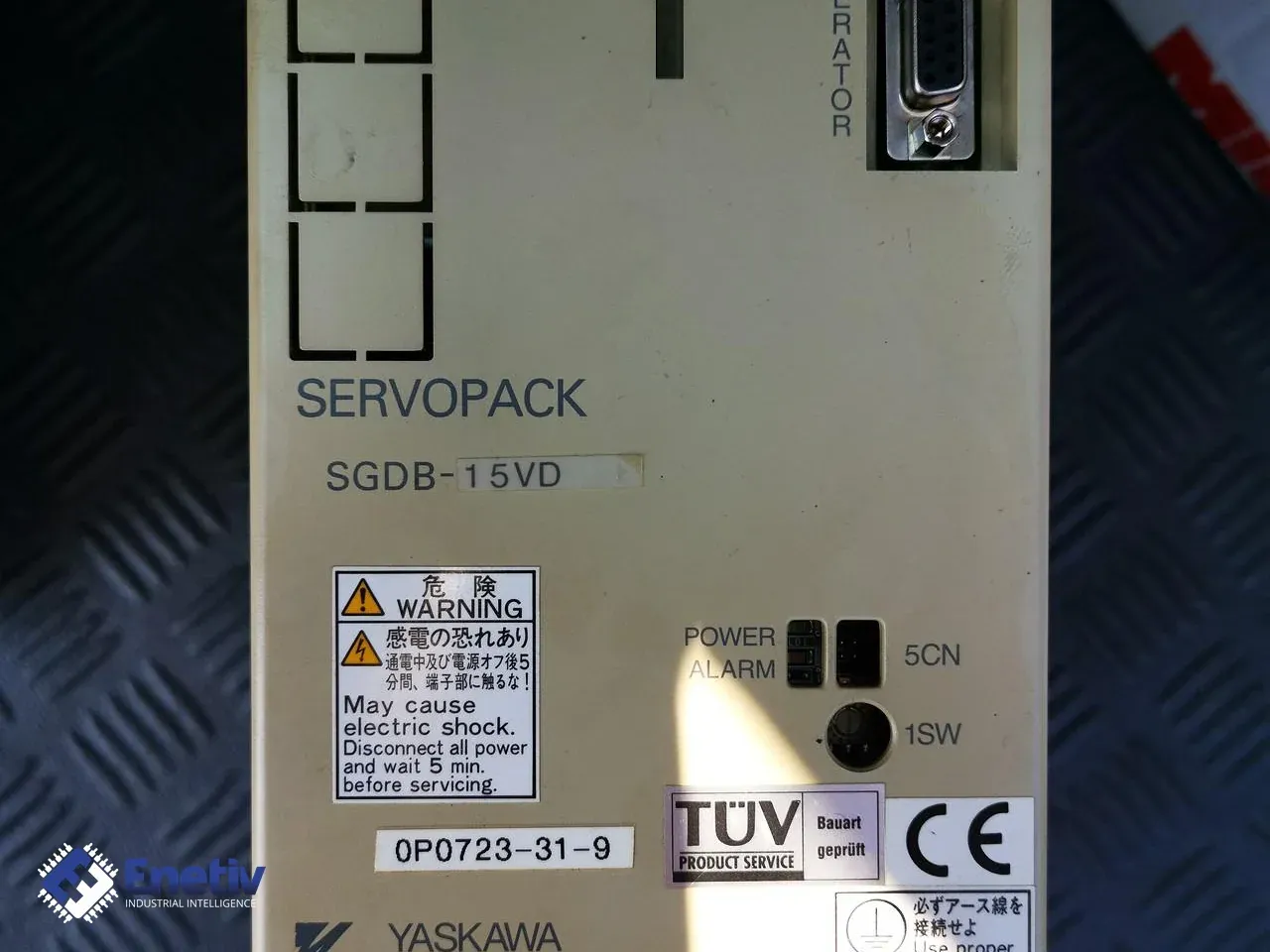
A Servopack is the amplifier that drives a servo motor on a machine axis, so when it fails the simplest fix is a unit of the same type. What to check when buying a used Yaskawa SGDB-15VD with catalogue number 0P0723-31-9.
Used Yaskawa Servopack SGDB-15VD (0P0723-31-9) – what to check before buying
A Servopack is an amplifier that controls a servomotor on a machine axis, and in older machine tools and woodworking routers it works together with the servomotor, the host controller and the operator panel. When such a drive fails and the machine otherwise works, the simplest solution is to find a unit of the same type. That is why people look for the Servopack SGDB-15VD with catalog number 0P0723-31-9, including used units.
Brief description of the device
The SGDB-15VD belongs to the SGDB servo drives of the Σ series, and the SGDB series manual gives operating conditions that apply to the whole series, not specifically to the VD variant. The ambient temperature of the servo drive is to be within the range from 0 to 55°C, which means that the control cabinet must provide such conditions also in summer and when working under load, not only in a cool workshop. When mounting side by side, the SGDB series manual requires a spacing of at least 10 mm between servo drives and at least 50 mm above and below them, because these spaces ensure air circulation and cooling. When replacing a drive in an existing cabinet, you should therefore check that these spacings are kept, because tight mounting shortens the life of any drive, new or used.
What to watch out for when replacing
When buying a used unit, the greatest certainty comes from comparing it with the drive being replaced, so the following points are checked:
- Full designation from the nameplate: the catalog number 0P0723-31-9 and any suffix after the type name should match the designation of the old drive.
- Serial number and hardware version: it is worth reading and noting them, because they allow the unit to be described unambiguously and compared with the previous one.
- Inspection of the housing and connectors: look for damaged contacts and signs of overheating, which reveal earlier overload.
- Connector markings on the housing: they are compared with photos of the current installation, without assigning functions to them, so that every wire goes back to the same connector.
- LEDs and display after power is applied: their behavior at startup shows whether the drive starts up at all.
- Labels with the software version: they should be read and noted, so that you know which unit is going into the machine.
- Inputs and outputs: their values are checked with a calibrator or a current source, which makes it possible to detect incorrect readings before installation.
- Origin of the part: it is good to document it, together with photos of the nameplate, because this makes later servicing easier.
- Settings backup of the servo drive: it is made before the replacement, because once the old drive has been removed there is nothing left to read it from.
The SGDB series manual contains a note from the manufacturer to use the specified combination of servomotor and SERVOPACK, which is the reason why, before buying, you need to have the designations of both devices at hand. The manual also requires waiting at least five minutes after switching off the power before service work, because that is how long it takes for the drive to discharge, and this applies to replacement as well. From other sources: on the LinuxCNC forum a user described a Morbidelli Author 600KS machine with a "SGDB-15VD Y104" drive and a "SGM-09V2ABB" motor, but this is an account from a forum, not manufacturer data or a confirmation of compatibility.
General replacement steps
The work begins with a settings backup of the old servo drive, then its designations are read and all the wiring is photographed, so that after installation every wire goes back to its place. On this basis a part matching the read designation is chosen, and after waiting five minutes from switching off the power the old drive is removed. The new unit is mounted keeping the spacings from the SGDB series manual, that is at least 10 mm between servo drives and at least 50 mm above and below them, after which the wiring is connected according to the photos. At the first start-up the LEDs and the display are observed, and then the inputs and outputs and the communication with the controller are checked before the machine returns to operation. The manual also describes operation with the handheld operator panel JUSP-OP02A-1 and the mountable panel JUSP-OP03A, which are useful for reading and checking the drive settings, although they are not associated with the connector markings on the housing.
Questions and answers
What data should you prepare before inquiring about a used unit?
Photos of the nameplate of the old drive, its serial number, hardware version, and photos of the wiring and connectors are useful. With such a set it is easy to compare the designation 0P0723-31-9 and any suffix after the type name with the offered part.
Enetiv works in industrial automation from two sides: we supply parts and we repair them. We have new, used and refurbished parts from brands including Allen-Bradley (Rockwell Automation), Siemens, Schneider Electric, Bosch Rexroth and ABB, we diagnose and repair inverters, servo drives, I/O modules and controllers, we service motors and servomotors, with our own warranty on repairs. We also specialize in end-of-life (EOL) parts and service, including older-generation and unusual components. Please contact us at https://enetiv.com/zapytanie.
Sources
- Yaskawa (copy hosted by Mroelectric) — SGDB Σ-Series SERVOPACK – SGDB series manual, manufacturer document (English version)
- LinuxCNC Forum — Morbidelli Author 600KS – retrofit / tear down, thread on the LinuxCNC forum (English version)
Publication date: 23.11.2026